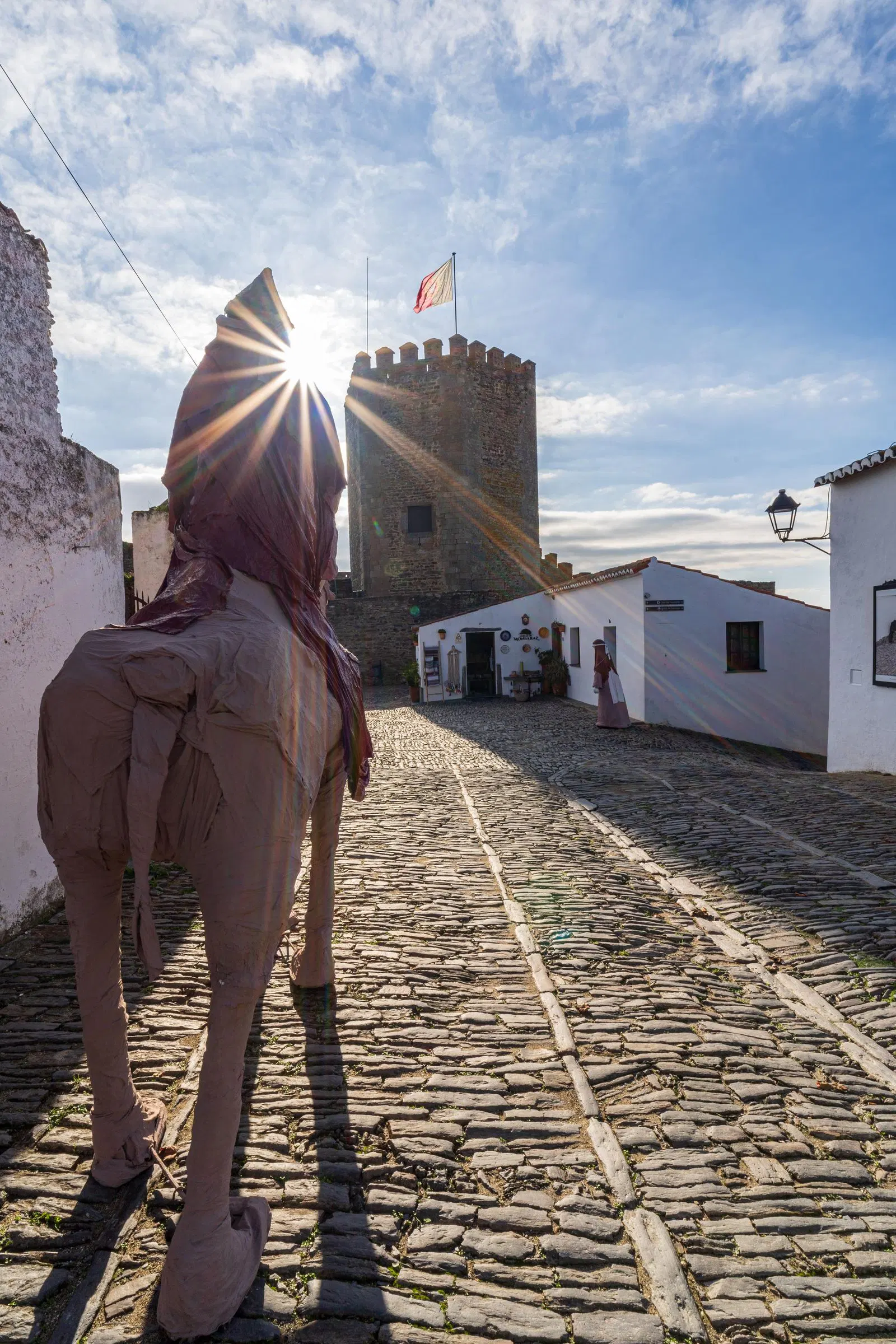
Mourão Castle stands at the highest point of the village, a few minutes' walk from any street in the centre. It is a 14th-century Gothic castle with the parish church built into its wall and a second, star-shaped ring of walls from the 17th century. There is no ticket, and in the late afternoon it is the best viewpoint over Alqueva on this side of the lake.
Do not expect a walled village like Monsaraz: here the walls enclose ruins, the church and a wide open space you wander at your own pace. What makes it worth the climb is history you can read on the stone, and the landscape — plain on one side, water on the other, with Monsaraz on the hill opposite.
Who built Mourão Castle
The answer is carved by the gate. According to the Portuguese heritage register (Património Cultural), the inscription beside the main entrance records that King Afonso IV ordered this castle begun in 1343, and that the master builder was named João Afonso.
Mourão had a history before that. In the 13th century it was disputed between Portugal and the kingdom of León; Mourão town council refers to a fortification built or rebuilt in 1226, under King Sancho II — the year of the first charter, granted by Gonçalo Viegas, prior of the Order of the Hospital. The Treaty of Alcañices (1297) settled the village on the Portuguese side. In 1313 King Dinis granted it to Raimundo de Cardona on one curious condition: that he build no fortress. The castle you see today came thirty years later, on the king's own orders.
Two more phases followed:
- First half of the 16th century — the brothers Francisco and Diogo de Arruda, royal architects, added the barbican and the moat and reinforced the whole.
- After 1640 — with the Restoration of Portuguese independence, Mourão became a serious frontier again. The engineers Nicolau de Langres and Pierre de Saint-Colombe gave the medieval castle a double ring of walls in the manner of Vauban, with pointed ravelins and a star-shaped plan built for artillery.
The castle has been listed as a Property of Public Interest since 1957.
What is inside the walls
The medieval enclosure is roughly trapezoidal, its towers linked by a wall-walk. The main gate faces west and is guarded by two square towers, as was the rule in Gothic castles. Inside:
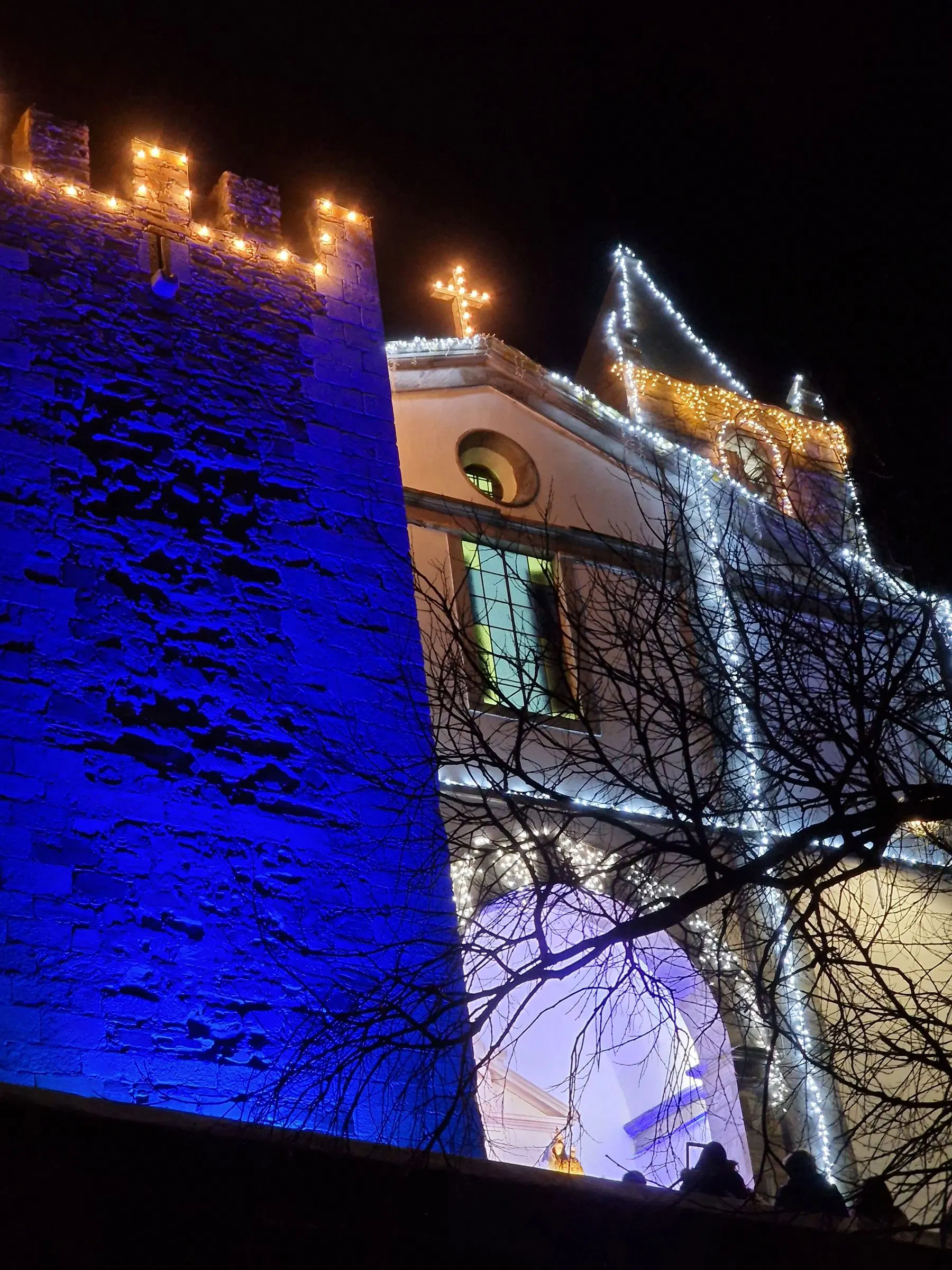
- The parish church of Nossa Senhora das Candeias. Not a castle chapel: this is the village's main church, built from scratch inside the walls. Work began in 1681 on the orders of the prince regent Pedro (later King Pedro II), to a design by the engineer Diogo Pardo Osório, and it was consecrated in August 1692. The façade sits between two Gothic towers. The earlier medieval church had been demolished in 1664 to make way for the bastions. The 1755 earthquake damaged the vault of the chancel, later rebuilt. Inside, a polychrome carved high altar and the limestone statue of the patron saint, which has survived three rebuildings of the church.
- The old governor's houses, built against the north wall, now in ruins.
- The keep and the surviving towers. The walls are local schist, marble and granite, and you can see the stone change from one stretch to the next.
- Cannon displayed in the enclosure, which children find before any adult does.
The outer star-shaped wall wraps around all of this and is best seen from a distance — from the road to the lake beach or from the bridge towards Monsaraz.
What you see from the top
Three things, depending on which way you look:
| Direction | What you see |
|---|---|
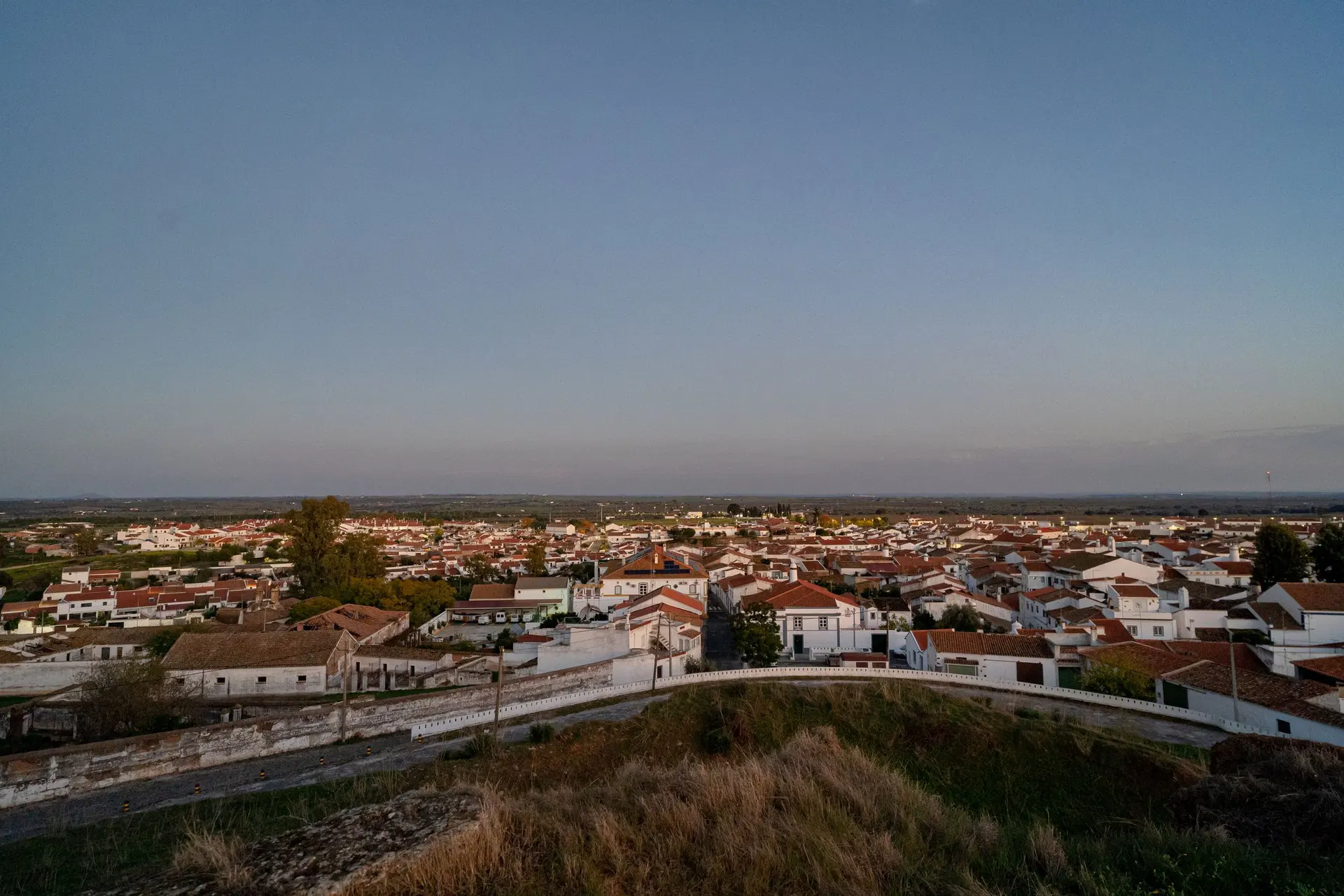
| Down | The white houses of Mourão, the chimneys and the storks' nests |
| East | The Alentejo plain stretching as far as Spain |
| West | The Great Lake of Alqueva and, across the water, Monsaraz on its hill |
That last one is what brings people up here. The two castles face each other across the lake, and in the late afternoon the sun sets directly over the water. Climb Monsaraz Castle and you see Mourão in the distance; climb this one and you see Monsaraz. Worth doing both, on different days.
Opening hours, price and how to get there
Alentejo Tourism lists the castle as always open, with no closing day; Turismo de Portugal describes it as an open enclosure. Entry is free and there is no ticket office.
If you need to be certain of a particular time — or want to know whether the church is open — ask at the Mourão tourist office: Largo das Portas de São Bento, 9am to 12.30pm and 1.30pm to 5pm, telephone +351 266 560 010. The castle's address is Rua Frei António das Chagas.
On foot from the village centre it is a short climb. The route Alentejo Tourism suggests starts at the tourist office, goes up Estrada da Barca and turns into Rua Frei António das Chagas as far as the castle gate. From Casa de Santa Margarida it is a few minutes.
How long it takes and the best time
Thirty minutes to an hour is enough to walk the wall-walk, step into the church and stop at the viewpoints.
The best light is the last hour before sunset: the lake turns silver, then orange, and the walls take on the colour of the schist. Early morning also works, with the sun behind you lighting up Monsaraz. At midday in summer it is just hot stone.
At night the outline of the wall is lit — Mourão town council completed the LED lighting in March 2025, except for the tower by the entrance, which was under restoration at the time. You can see it from any street in the village and from the road in from Monsaraz.
The miniature castle
If you searched for the "miniature of Mourão Castle", this is it: a scale model of the castle and parish church on one of the village roundabouts. You see it in passing, from the car. It is not an attraction with hours and not worth a stop of its own — the original is a few minutes away, at the top of the hill.
What to do next
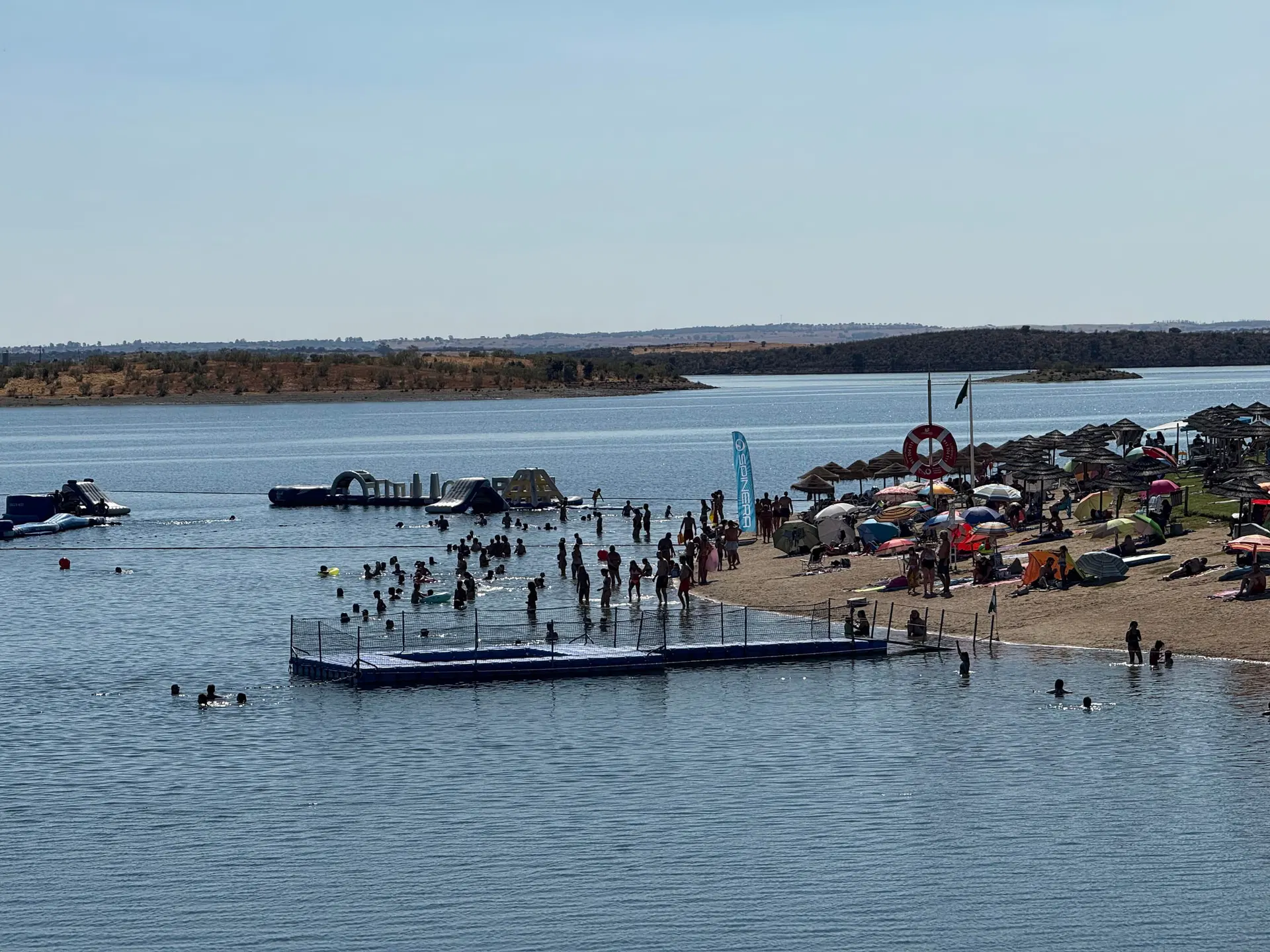
- Mourão lake beach — 5 minutes by car. In summer the plan writes itself: castle in the late afternoon, a swim before or after.
- Monsaraz — 20 minutes, over the bridge across the lake. The castle on the other side.
- The rest of Mourão — the Misericórdia church, the cafés on the square, the ethnographic museum.
- Dark skies — if you stay until nightfall, you do not need to leave the village to see stars; for more, the Cumeada observatory is 25 minutes away.
- Mourão's festivals — in late January and early February, the church in the castle is the centre of the patron saint's celebrations.
What this castle is not
It is not Monsaraz. There are no shops or restaurants inside the walls, no ticket office, no scheduled guided tour. It is an open enclosure with ruins, a church and a view. If you like your castles tidy and restored it may feel like too little; if you like having the place to yourself at sunset, it is one of the best on Alqueva.
Casa de Santa Margarida is in the centre of Mourão, a few minutes' walk from the climb to the castle. Go up before dinner, come down in time to eat it in the village.
Common questions
Who built Mourão Castle?
King Afonso IV. According to the Portuguese heritage register, the inscription by the main gate records that the king ordered the castle begun in 1343 and names the master builder as João Afonso. Mourão town council mentions an earlier fortification from 1226, under King Sancho II. The star-shaped outer walls were added in the 17th century, after 1640.
Does Mourão Castle have opening hours or a ticket?
Alentejo Tourism lists the castle as always open with no closing day, and Turismo de Portugal describes it as an open enclosure. There is no ticket. If you need to be sure of a specific time, check with the Mourão tourist office on Largo das Portas de São Bento, open 9am to 12.30pm and 1.30pm to 5pm (+351 266 560 010).
What can you see from the top?
The village below, the Alentejo plain stretching to Spain and, to the west, the Great Lake of Alqueva. Across the water, on its hill, is Monsaraz — the two castles face each other over the lake.
How long does the visit take?
Thirty minutes to an hour. It is a few minutes' walk from the village centre, the climb is short and the circuit of the wall-walk is done at an easy pace. In the late afternoon you will stay longer than planned.
Is there a church inside the castle?
Yes. The parish church of Nossa Senhora das Candeias is built into the wall, its façade set between two Gothic towers. It was begun in 1681 on the orders of the prince regent Pedro and consecrated in August 1692, according to Mourão town council.
What is the miniature of Mourão Castle?
A scale model of the castle and church on one of the village roundabouts. You see it in passing, from the car; it is not a site with hours or a visit. The real castle is a few minutes away, at the top of the village.